

Who’s right in the Bryan Schott press pass lawsuit?
Schott? Or the Legislature’s staff?

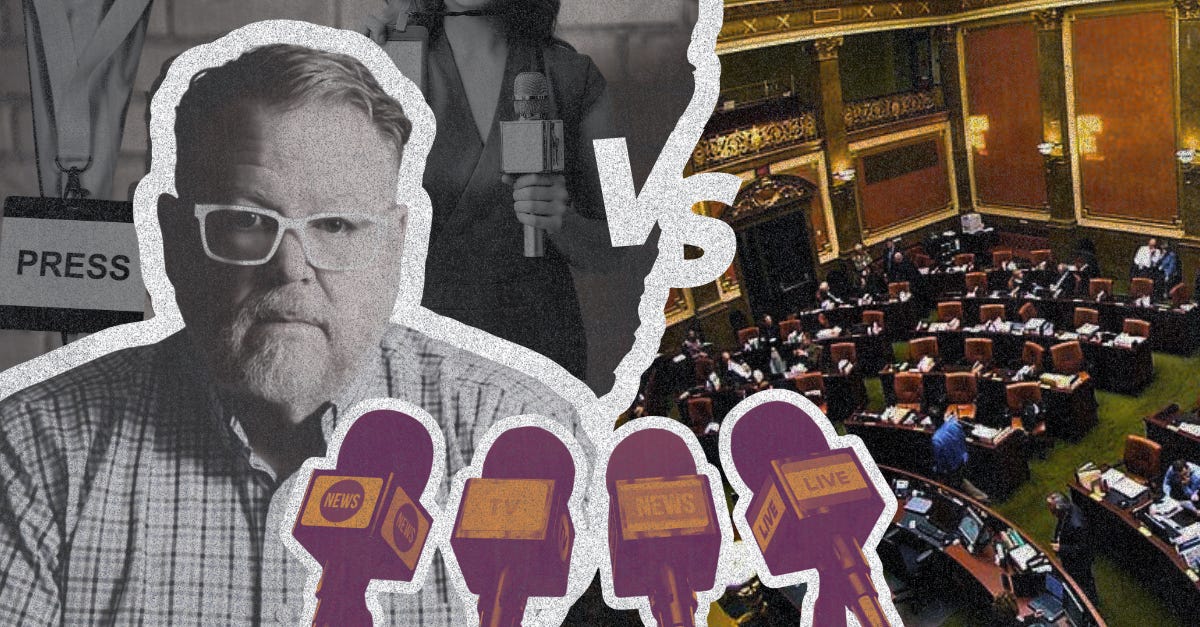
Last month, the Tenth Circuit Court of Appeals revived a First Amendment case between staffers at the Utah Legislature and Bryan Schott, editor-in-chief and sole owner of Utah Political Watch (UPW). The largely overlooked case could shape whether independent journalists — like bloggers, podcasters, and freelancers — are treated the same as traditional media when government officials decide who gets access to press spaces and events.
Schott sued four legislative staffers after they denied him a press pass, a privilege he had enjoyed since the Legislature started issuing them in 2013. Officially, the staff said it was because he was no longer tied to a major news outlet. Schott says the real motive was more nefarious: They didn’t like his reporting.
Either way, the bigger question is whether either rationale was legitimate grounds for denying him the same access given to other journalists.
Some background
Schott has covered Utah politics since 1999, working for established news outlets including UtahPolicy.com, KUER, KSL NewsRadio, and The Salt Lake Tribune. He held a legislative press credential every year after the Legislature began issuing them in 2013. But in 2024, he left the Tribune and launched Utah Political Watch, a subscription news site where he serves as owner, publisher, editor, and sole reporter.
That’s when his credentialing problems began.
What does a credential actually get you? It gets you access to the press room, designated workspaces in the House and Senate galleries, media parking, and in-person access to press conferences and “media availabilities” with elected officials, where you can ask questions.
After Schott first inquired about getting a press pass for the 2025 session, the Legislature revised its credentialing policy. An earlier version allowed bloggers and independent outlets to receive credentials in “limited, rare circumstances.” The new policy flatly excluded “blogs, independent media, or other freelance media” and reserved credentials for journalists working for an “established reputable news organization.”
The dispute escalated in December after Schott published a story about an ethics complaint involving Senate President Stuart Adams. The same day, Adams called Schott out on X. The senator referred to him as a “former media member” and described his work as “part of a troubling pattern of neglectful journalism that undermines the profession’s integrity.” His post was reposted on the Utah Senate’s Facebook and Twitter pages before being removed.
When Schott later reached out to Senate Deputy Chief of Staff Aundrea Peterson for comment, Peterson echoed Adams’ criticism in a text exchange, quoting parts of Adams’ post word-for-word. She referred to Schott’s news outlet as a blog five times and used phrases like, “someone who claims to be a journalist,” “failing to follow basic journalistic standards,” and “lack of journalistic integrity.” Schott asked whether she would deny his credential application because of the Adams story. Peterson replied that she would follow the credentialing policy.
Schott applied for a press credential December 17 and was denied under the new blogs-and-independents exclusion. His appeal to House Chief of Staff Abby Osborne and Senate Chief of Staff Mark Thomas failed on December 26. According to the letter from Osborne and Thomas, leaving The Salt Lake Tribune meant Schott was no longer a member of the professional media.
On January 22, 2025, Schott and Utah Political Watch, represented by the Institute for Free Speech, sued Peterson, Osborne, Thomas, and House Communications Director Alexa Musselman. They asked the court to order the Legislature to give Schott a press pass and award him $17.91 in damages (a nod to 1791, the year the First Amendment was ratified).
Legislative staffers say the denial had nothing to do with Schott’s reporting. Their position is that press passes aren’t protected by the First Amendment. The passes offer special access to limited Capitol spaces and events, so the Legislature may reserve them for reporters who work for established organizations with editors and institutional oversight.
Schott says that explanation is a pretext. In his view, staffers changed and applied the policy to shut him out because they disliked his viewpoints and combative reporting style. He also argues that the rules give officials too much power to decide which journalists count as legitimate. And he says they weren’t applied evenly. According to his complaint, the Legislature credentialed reporters from Utah News Dispatch when it was only a month old, Building Salt Lake despite its inclusion on a list of urban planning blogs, and solo editor-operators at the Davis Journal and Utah Policy, all while excluding Utah Political Watch.
Growing tension with the Legislature
Even before he left the Tribune, Schott’s reporting had drawn some heated responses from staff and legislators.
In addition to the clash over the Stuart Adams article, court documents cite several examples from the 2024 legislative session in which Schott criticized the Utah Legislature and its leaders. One article accused House Speaker Mike Schultz of dodging questions. Schultz later messaged Schott, accused him of bias, and told him, “You used to be the best reporter in the Legislature. It’s sad how far you’ve fallen.”
In a separate incident, Schott posted on social media about legislative staff struggling to set up a backdrop, and House Chief of Staff Abby Osborne publicly criticized him on X: “Bryan, you are a d***! As a reporter, I can’t believe you think it’s okay to blast staff for doing their job. You could have got up and helped, but you chose just to tweet about it.”
Staffers maintain that these clashes had nothing to do with Schott’s denial. In their letter rejecting his appeal, Osborne and Thomas wrote, “Any claim that recent updates to the policy were intended to prevent targeted individuals from obtaining credentials is inaccurate and completely unfounded.”
Where things stand
A federal judge threw out Schott’s lawsuit on Sept. 29, 2025, agreeing with legislative staffers that a Capitol press pass gives reporters special access, not a constitutional right, and that Schott could still cover the Legislature through public meetings and records.
However, on June 30, 2026, the Tenth Circuit Court of Appeals unanimously revived part of the case. The judges said Schott had alleged enough to continue pursuing his claim that officials denied him credentials because of his reporting. They did not decide whether he was actually targeted or whether the policy was unconstitutional. Instead, they found that the timing, staff criticism, and alleged exceptions for other independent outlets raised factual questions worth examining more closely.
In a 47-page opinion, Circuit Judge Timothy Tymkovich explained that the Legislature’s argument that Schott could still access the same basic information did not automatically end the First Amendment question. By creating a credentialing system for reporters who want access to Capitol media spaces and events, the Legislature created a limited public forum or a nonpublic forum. Both are government-controlled spaces where access can be limited. But those limits still have rules. Under past court decisions, the Legislature may decide who gets into that forum, but its criteria must be reasonable and cannot discriminate based on viewpoint.
Tymkovich also raised questions about how “neutral” the credentialing policy really is. He noted that phrases such as “reputable news organization” and “professional member of the media” are subjective, giving legislative staff broad discretion to decide who qualifies for a pass and who does not.
What Schott’s supporters are saying
Freelance journalists are journalists. The new policy is outdated and out of step with modern journalism.
When the government opens its doors to the press, it cannot admit only the reporters it likes. Which is what happened here.
Our nation’s founders foresaw this tension, and legislated to protect journalists’ press access.
In the Salt Lake Tribune, Caitlin Vogus, senior advisor for Advocacy at the Freedom of the Press Foundation, said the policy excluding all independent journalism hurts Utahns:
“Lesson number one: Freelance journalists are journalists.
“It’s a principle that dates back to our country’s earliest days. The founders recognized that freedom of the press included not just newspapers and books, but also the pamphlets published by individuals that fueled the American independence movement. . . .
“Maybe lawmakers don’t believe freelancers who publish online are journalists. But the Supreme Court disagrees. So does Utah Sen. Mike Lee, who last Congress co-sponsored a federal shield law that would have protected freelance and independent journalists from being forced to reveal their sources. Utah’s own reporter-source shield law also covers independent reporters.
“More importantly, excluding independent journalists reduces Utahns’ access to information. These days, people across the political spectrum get their news through social media, podcasts, newsletters and even blogs. But Utah’s new policy would bar everyone from Joe Rogan to Paul Krugman from receiving a press credential.”
Charles Miller, senior attorney for the Institute for Free Speech and lead counsel for Schott, said the Tenth Circuit ruling was a win for independent journalism:
“Today’s ruling makes clear that, when the government opens its doors to the press, it cannot then pick and choose who gets to walk through those doors based on whether officials like what a journalist writes. Utah’s Legislature revised its credentialing policy to exclude independent journalists right after a veteran reporter who covered the Capitol for decades and was known for asking tough questions started his own news site. Schott was the only journalist denied credentials.”
The Foundation for Individual Rights and Expression (FIRE) argued that this situation was similar to Representative Aedanus Burke trying to expel newspapers from the House floor in 1789.
“The House rejected Burke’s proposals based on what members of the First Congress believed the First Amendment required. . . . This episode demonstrates that members of the First Congress, who were uniquely well positioned to understand the original meaning of the First Amendment, understood the Speech and Press Clauses to preclude the government from denying journalists access to legislative spaces based on (or in retaliation for) the content and viewpoints expressed in their reporting.”
What critics of Schott are saying
A press pass provides access, not a separate speech right.
Schott could still cover public proceedings without one.
Staffers’ legal team says the appeals court created a new constitutional right.
In a response to the original complaint, Tyler Green of Consovoy McCarthy, lead counsel for the staffers, asserted that a press pass is access, not speech.
“The crux of [Schott’s] argument is that because [he] is a reporter, he has a right of access ‘equal to the rights of other credentialed media representatives.’ That reasoning would invalidate any attempt to credential some media but not others. Courts have rejected [this]’ theory as unworkable, and for good reason: Every self-proclaimed journalist or reporter — from blog-site owners to TikTokers — would have the same right of access as established, reputable news organizations. That is not the law.
“A government’s distinctions among members of the press in a limited or nonpublic forum are constitutional so long as they are reasonable and viewpoint neutral. The Legislature’s policy clears those thresholds. It ensures that established media maintain sufficient access while maintaining substantial alternative channels for news gathering.”
U.S. District Judge Robert Shelby initially ruled against Schott, reasoning that reporters can still cover the Legislature without a press credential.
“Any reporter has access to the legislative session and is not restricted in the content of any potential publication,” Shelby wrote. “A media credential permits access to the press room, workspaces in the Senate and House galleries, designated parking and press events with elected officials. However, members of the public have access to the chambers’ galleries and may observe committee meetings and legislative floor debates. Additionally, legislative agenda items and other materials are posted on the Legislature’s website, and all official legislative action is livestreamed and archived on the Legislature’s website.”
After the appellate court ruling, staffers’ legal team argued the three-judge panel invented a new constitutional right.
“The panel crafted a new, freestanding “constitutional right” of “viewpoint-neutral access to a government-created forum” — irrespective of whether the First Amendment protects [Schott’s] intended activities. . . .
“But credentialed media have no greater access to government information than the public. ‘[T]he Capitol is open to all’ to ‘attend committee meetings and floor time.’ Committee meetings, legislative floor debates, agenda items and materials are readily accessible on the legislative website.”
My take
Schott may be combative and abrasive, but the First Amendment matters most when the government is dealing with critics it would rather avoid.
The timing, uneven enforcement, and vague standards make the Legislature’s policy look less like neutral credentialing and more like an attempt to solve the Bryan Schott problem.
The rise of independent media is a return to the decentralized press culture the First Amendment was designed to protect.
There is something wonderfully American about this whole dispute: the government made a decision, a citizen cried foul, and now everyone has to meet in court and argue about the First Amendment. Whatever we think of Schott, the fact that he can challenge the Legislature and force it to defend its decision to exclude him is worth celebrating.
This is not a failure of the system. This is the system.
Before the Constitution and Bill of Rights, British and colonial officials were largely free to prosecute (or persecute) anyone they believed guilty of “seditious libel.”
Which is why the Founders wrote the First Amendment without much room for equivocation:
“Congress shall make no law . . . abridging the freedom of speech, or of the press. . .”
Does Bryan Schott have a track record for antagonizing people in authority? Absolutely. Has that made him enemies? Almost certainly. Have public officials complained about his tone, methods, and coverage? Repeatedly. Has his approach sometimes veered into the inappropriate? Many would say yes.
So what?
If the First Amendment protects only reporters that public officials enjoy dealing with, what exactly is it protecting?
About the staffers in question. I can understand the desire to be free of Schott. A quick look at his news site and Instagram, and I’m glad he’s never had a reason to post about me. It’s not hard to imagine some staffers quietly celebrating when he left The Salt Lake Tribune, only to find out that their less-than-favorite reporter would in fact still be at the Capitol, this time with his own outlet and no Tribune-imposed guardrails to rein him in.
I suspect staffers saw the credentialing policy as a quiet way to solve what they viewed as the Bryan Schott problem. The timing is just too convenient not to be deliberate.
Schott had been credentialed for years while reporting for established news organizations. Then, on Nov. 5, 2024, he told legislative staff that he would be covering the 2025 session for Utah Political Watch and asked about obtaining credentials. Less than three weeks later, the media team created a revised policy categorically excluding “blogs, independent media outlets or freelance media.” The document’s metadata dates its creation to Nov. 24.
There is also the question of whether the Legislature applied its new policy evenly. The rules exclude blogs, yet Schott’s legal team points to Building Salt Lake, which received credentials and appears to fit that description rather comfortably.
Charles Miller, Schott’s lead attorney, noted that the site’s About page once described it as a “Top 100 Urban Planning Blog.” By the time of this writing, “blog” had been replaced with “source.” The link, however, still leads to a list of urban planning blogs — an awkward detail for anyone arguing that the distinction is perfectly clear.
If staffers expected Schott to accept the new policy and move on, they badly miscalculated. What may have looked like a quiet way to avoid dealing with him has instead produced a federal lawsuit, mounting legal costs, and far more scrutiny than the original credential request ever would have attracted.
That is the fundamental mistake. The staffers appear to have been using the policy as a shield. Instead, its vague language left them exposed. Standards based on reputation, ethics, and professionalism may sound reasonable on the surface, but they leave ample room for personal judgment (and personal grievances) to creep in.
A stronger policy would rely on concrete, measurable criteria: how often an outlet publishes, the size of its readership, whether it produces original reporting, and whether it provides bylines, public contact information, and a corrections policy. Had the Legislature adopted standards like these from the beginning, this lawsuit might never have happened.
Clarifying the policy now would not only make room for legitimate independent journalists. It would also protect legislative staff from being dragged into the next avoidable legal battle.
But the larger issue is not just Schott. The Legislature had already been tightening access for independent journalists before he applied. Until the November 2024 revision, blogs and freelancers could still receive credentials, but only as exceptions to a rule that otherwise excluded them.
Attorneys for the staffers said the change reflected concern about a growing number of independent journalists seeking access. Even if that is true, a point Vogus strongly disputes in her op-ed, restriction is the wrong response.
“The Legislature should be celebrating the enhanced coverage that independent journalists bring to the statehouse and finding ways to accommodate them,” she wrote in The Salt Lake Tribune. “If the Legislature actually received thousands of credential requests — an unlikely prospect for a statehouse — that would be a win for transparency.”
The revised credentialing policy seems to reflect a broader discomfort with the changing media landscape. Newsletters, podcasts, small investigative outlets, and independent commentators have blurred the old lines between reporting, opinion, and advocacy. The traditional model was easier to define. It was also easier to manage.
Schott’s case tests how far the Legislature can go in drawing those lines. It had credentialed him every year since 2013. What changed was not his experience covering Utah politics, but his employer. He no longer worked for a large, traditional news organization.
Rather than defending journalism standards, the revised policy seems designed to preserve the old media model.
But independent journalism is not a departure from the First Amendment’s roots. It is much closer to them. When the Bill of Rights was ratified, “the press” did not mean a professional class of reporters working for large institutions. Anyone with access to a printing press could weigh in on the government’s choices, whether the message was supportive, hostile, or somewhere in between.
Early American journalism was partisan, opinionated, and messy. What mattered was not whether officials approved of a publisher’s tone or credentials, but whether people were free to circulate ideas and challenge those in power.
The rise of independent media looks less like the collapse of traditional journalism and more like a return to the decentralized press culture the First Amendment was designed to protect.
I agree with Vogus, Miller, and the Institute for Free Speech. Independent journalism deserves clearer, more objective credentialing standards — and more room at the Capitol.
Think we got this one wrong? We want to hear about it.
The sharpest reader responses may end up in a future article.