

Was the Box Elder data center really that bad of an idea?
Reporting and research by Ella Reynolds

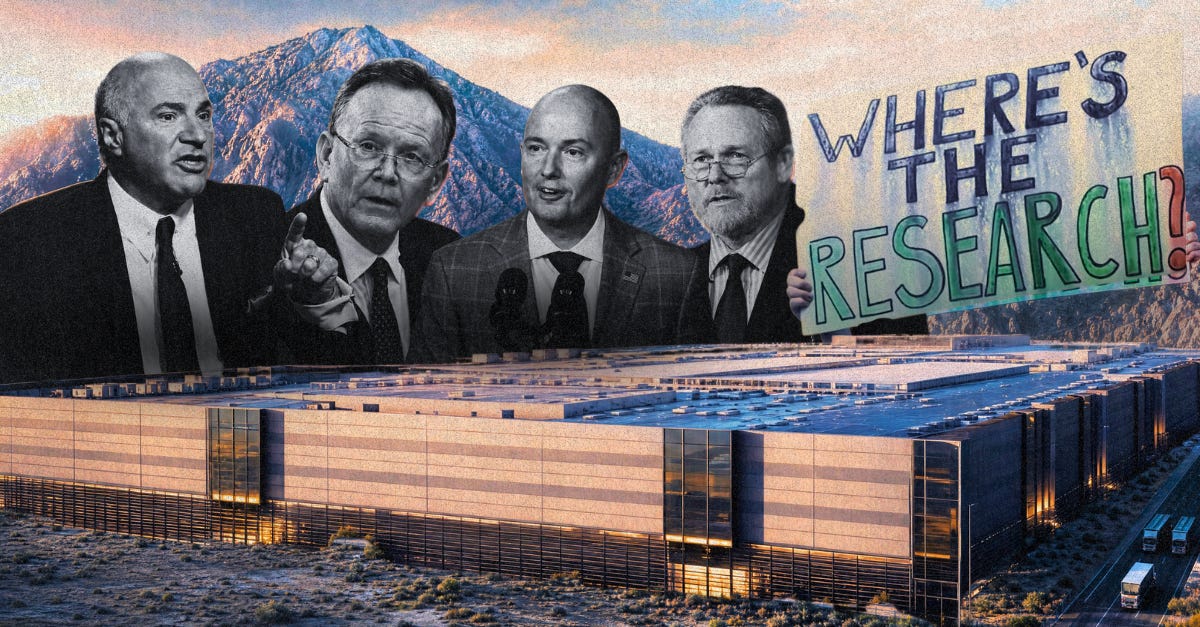
On June 23, Utah voters did something that hadn’t happened in modern state history: they fired a sitting Senate president in a primary. Stuart Adams lost to attorney Stephanie Hollist, an outcome that nearly everyone who studies Utah politics attributes to one thing: a hyperscale data center located in Box Elder County called the Stratos Project.
Now that the political dust has settled, I want to know, was the project itself actually a bad idea? What was actually being proposed? And was Box Elder County getting the raw end of the deal?
Below is the background, both sides’ most persuasive arguments, and then I’ll share where I landed after more research than I care to relive.
Some background
Sometime in 2025, Jason Chaffetz helped to introduce some Utah developers to his friend Kevin O’Leary, with a big, bold idea. Create a hyperscale datacenter in the middle of Box Elder County, powered by a $3.5 billion natural gas pipeline that was already sitting there.
Mr. Wonderful liked it.
So in January 2026, Kevin O’Leary met with Gov. Cox to pitch a hyperscale data center campus in Hansel Valley, a remote stretch of ranchland near the northern tip of the Great Salt Lake. The project, developed by O’Leary Digital and West GenCo, would span about 40,000 acres (although the datacenter itself would be less than 10,000 acres), and eventually draw up to 9 gigawatts of power from on-site natural gas plants. Utah’s entire statewide demand is roughly 4 gigawatts. O’Leary has said the buildout could eventually exceed $100 billion, with a first tranche of about $15 billion.
The approval ran through the Military Installation Development Authority, or MIDA, a state entity created to support defense-related development around Hill Air Force Base. Adams chaired MIDA’s board. Because MIDA has its own land-use authority, its involvement let the project bypass ordinary county zoning and public review. MIDA’s board authorized the project area with 100% property tax relief, and the applicable energy tax was cut from the standard 6% to 0.5%.
State law still required the county’s consent, and that’s where the public first got a real look at the proposal. On May 4, about 1,100 people packed the Box Elder County Fairgrounds; the three commissioners unanimously approved the two required resolutions while the crowd booed, chanted “people over profit,” and, at one point, was told by Commissioner Boyd Bingham, “For hell’s sake, grow up.” The commissioners left the room and broadcast their vote to the audience on a screen.
After that, quite a bit happened. In rough order:
The water fight. An application to convert 1,900 acre-feet of ranch water to industrial use for the project drew nearly 4,000 formal protests, and was withdrawn. A second, smaller application drew about 700 protests and was withdrawn too. Developers say they’ll re-file with better hydrology, and that the campus will run closed-loop cooling using roughly 13,000 acre-feet of rights already attached to the land, of which they expect to consume 500 to 2,185 acre-feet a year.
The referendum fight. A group of residents organized as the Box Elder Accountability Referendum (BEAR) filed to put the county’s consent on the November ballot. County Attorney Stephen Hadfield rejected the applications, ruling the resolutions were administrative acts under the MIDA Act and therefore not referable to voters. BEAR sued in 1st District Court to overturn that ruling; a separate nonprofit suit challenges MIDA’s code itself. Both cases are pending.
The state’s course correction. Cox signed Executive Order 2026-03 on May 29, directing state agencies evaluating data centers to prioritize the Great Salt Lake, water, air quality, ratepayers, and public transparency. Days later, Adams publicly demanded a 75% cut to the project area, and O’Leary agreed to shrink it, first to about 20,000 acres and then, per O’Leary Digital, to a 10,000-acre campus.
The June Primaries. Voters didn’t seem to feel that this reduction was enough. A Deseret News/Hinckley Institute poll found opposition to the project rose from 53% of Utah voters in May to 60% in June, with Republicans swinging from net-positive to net-negative on it, and only 24% saying the downsizing made them more supportive. On June 23, Adams took 34% in a three-way race against Hollist’s 43%. Commissioners Bingham and Lee Perry from Box Elder County lost their primaries too.
O’Leary’s Chinese interference accusations. O’Leary went on national TV and claimed opposition groups were being funded by China — a claim he repeated across roughly ten media appearances. In June, he admitted he had no evidence for it. In July, the accused groups sued him and Fox News for defamation in Utah federal court. That lawsuit is still pending.
The project lives on. The MIDA designation was unaffected by the election, and developers say they hope to break ground on phase one within a year, pending water and construction permits.
What critics of the Stratos Project are saying
The physics of dumping this much heat and carbon into one desert valley are genuinely alarming.
MIDA let a private developer bypass zoning, taxes, and the voters. That’s a governance problem.
The State forced the project onto county leadership, leaving them with no good options to respond.
Robert Davies, a physics professor at Utah State University, told Grow the Flow that proponents' closed-loop and air cooling plans—meant to "reject the heat into the air—doesn’t eliminate the environmental issue.
“The thermal load from the proposed Stratos project is extreme. There is no way around the physics. This is the energy output of two-and-half New York Cities poured into a single confined desert basin, in a watershed that’s already in crisis. Of course it has effects. One of those effects is this: This facility imposes substantial drying on a watershed and ecosystem already in active collapse.”
In his preliminary analysis, Davies explained that “[In the daytime], elevated temperatures of 2-5 degrees Fahrenheit [occur] throughout Hansel Valley. This is nevertheless a significant increase. Nighttime is a different story [with] elevated temperatures of 8-12 degrees Fahrenheit. This is a very large impact.…. A permanent rise in nighttime temperatures of this magnitude... will essentially shut down this cycle. Condensation will not occur. This is the lifeblood of the ecosystem. The ecological impact resulting from the combination of elevated temperatures and suppressed nighttime condensation is likely extreme.”
In The Guardian, David Irvine, the attorney representing Alliance for a Better Utah and five Box Elder County residents in their lawsuit against MIDA, warned that the project could remove major decisions from local voter control.
“Under the Stratos plan, it would hold permanent, irrevocable control over public health, safety, taxation and land use across tens of thousands of acres of Box Elder County, with no voter recourse.”
Utah Clean Energy estimates the all-gas project could raise the state’s carbon emissions by 55% to 75%, depending on the system used.
Stephanie Hollist, the attorney who beat President Adams in the primary, argued the problem isn’t one project, but an agency with no voter accountability.
“What we’re seeing is an entity that has grown so big and has so many tentacles to unravel it will be challenging… We’re also seeing that MIDA is able to override land-use decisions and give developers benefits that a normal entity isn’t given…. There’s an energy tax benefit that is usually 6%. That was reduced to 0.5% for this project. Who is it that gets to make that call?”
House Speaker Mike Schultz placed a lot of blame on Kevin O’Leary.
“Kevin O’Leary spent his time lecturing Utahns instead of answering their questions. And it is a completely wrong approach. And I do blame Kevin O’Leary for this mess that’s out there, in large part.”
County Commissioner Lee Perry says the state backed the county into a corner where they made the only decision they could.
“Do I think that the data center vote cost me the election? Yes I do. Would I do anything different? … I wouldn’t vote differently, but I would push back against the state and make them come out publicly and tell everybody why they’re forcing it down our throat.”
What supporters of the Stratos Project are saying
It’s a generational economic win for a rural county.
America needs AI compute for defense and competitiveness, and this is the right place to build it.
The scary claims don’t survive contact with the actual plan, and phased construction proves it.
The Box Elder County Commission FAQ page points to local jobs, better services, and the possible offsetting of property taxes (Box Elder County just had a 37% property tax increase last year).
“In Phase One, the county expects to receive $30 million in annual tax revenue. When fully built out, it could generate up to $108 million every year.
Revenues will first cover all county municipal services (like roads, police and fire). The remaining funds will be used at the county’s full discretion, and a portion of the taxes will go to local taxing entities, including the school district.
There will be thousands of temporary construction jobs. Once built, it will create 1,000 to 2,000 permanent jobs for IT workers, engineers, and administrative staff. These jobs will not just be at the data center, but will be needed for the power generation, manufacturing and other businesses and projects included in the project area.”
Gov. Spencer Cox, in an article with KSL, framed the project as part of a broader technology race with China and as central to our national security.
“We have an obligation, I think every state has an obligation when it comes to this space, to allow for these types of data centers to be built in their states. We have to do this. We can’t just say no and shut the doors and go home and let China win this technology race.”
On the environmental alarms, O'Leary says come look.
“Why not build it so people come and see it, like phase it in? And so you don’t build the whole thing. Remember, we’re permitted for seven and a half gigawatts. Okay, let’s scale that back. Let’s build a smaller amount and let people look at it, and let’s see if they like the jobs and they like what it looks like, and how much water it’s using, how much noise it makes, and how much heat it generates as opposed to building the whole thing,”
The Governor’s FAQ sheet says this water would actually result in more water flowing to the Great Salt Lake.
“The systems use only existing water rights attached to private property, which means the project will have lower net consumption than current agricultural or ranching use. This reduction in water use will create a net benefit to the Great Salt Lake watershed. Additionally, the advanced closed-loop system will result in less net consumption compared to traditional data center operations… ongoing water demand at the campus is projected to be similar to that of a large office complex, with most water use limited to everyday needs such as restrooms, sinks, and employee facilities.”
My take
Winning the AI race against China is important, and this site is uniquely positioned to help.
The datacenter is a genuinely exciting opportunity for Box Elder County, with some big “ifs”.
Most of the environmental concerns will be reviewed before building. But the timing of the reviews is what caused backlash.
I feel for the Box Elder Commissioners. I think that most of us would have made the same decision in their shoes.
If you don’t believe that AI is the future, China sure does. And they’re gaining on us.
They’re building datacenters across the country (without holding a single townhall if you can believe it), and they’re achieving AI computing results nearly as good as ours for a fraction of the cost, with lesser chips. Oh, and they’re banning our chips in their shiny new state-funded datacenters because, I must emphasize, they believe this could be an existential race.
And the U.S. is in real danger of losing. We need to build some shiny new datacenters too. But to do that, we need land, water, and an insane amount of readily available energy.
And surprisingly, Box Elder County might check all of those boxes.
Land ✅ Water ✅
Governor Cox claims that buying perpetual water rights for a closed-loop system might actually save water for the Great Salt Lake. And that argument might actually hold some water (har har). Once you’ve got enough water for the closed-loop cooling, you don’t really need much more. This looks like a possible win-win-win scenario where farmers gladly sell their rights above market prices, the land continues to be leased for grazing, and the excess water goes to the Great Salt Lake. Could this datacenter be a water conservation project in disguise? That’s the kind of deep-state back-door dealing I can get behind.
Energy ✅
This is where the match starts to get soul-matey. Box Elder County happens to have a 683-mile, 42” diameter steel pipeline running beneath it that’s absolutely packed with underutilized natural gas. So O’Leary Digital plans to build its own private natural gas power plant(s) on top of the line, which will then power the datacenter. Utahns’ electric bills stay the same, and America gets more supercomputing.
Pretty cool. And we haven’t even gotten into the county benefits.
Bonus County Benefits ✅
Box Elder County currently operates on a budget of $76 million per year. In phase one of the Stratos project, the county is projected to receive ~$30 million per year, raising their annual budget by ~39%. Then in phase two, they hope to reach $108 million per year. This would balloon the county budget to ~$184 million/year, while the county itself stays roughly the same size.
You’re essentially handing this rural county some resort town taxes. And if you’ve ever been to a resort town, you know those out-of-state tax payments are transformational. Better services. Better roads. Better schools. Better better better.
So come on, Box Elder residents would be certified dummies not to accept this deal, right? Right??
Maybe.
We actually have no idea. Because while all of this sounds perfect, and at least moderately plausible, we don’t have any studies to confirm it.
We don’t know what the closed-loop datacenter system looks like, or how much water will actually fill that closed-loop.
We don’t know how much of the purchased water rights were previously used for irrigation, skinnydipping, or just going unused.
We don’t know whether the valley will actually go up 8-12 degrees at night once the datacenter is complete (and by the way, if it does, there’s nothing we can do about it. There’s no “you’re allowed to heat up the valley by X degrees” permitting process.)
We don’t even know that the tax revenue numbers are accurate. Only $5.4 million is guaranteed.
And Utahns seem to have a problem with that.
I was struck by this sign a resident held up at the May 4 Box Elder County hearing. “Where’s the research?” Just a simple question. But I think it pretty accurately summed up where the resentment and anger of citizens is coming from.
The process here has been:
Grant irrevocable control of 40,000 acres to MIDA.
Persuade citizens it was a good idea.
Then do the research that proves it was a good idea.
It’s a bit like me persuading my wife that the new minivan I bought an hour ago was the right decision because it was a really good deal and she’s gonna love it and also we can’t return it because I already drove it off the parking lot and signed the paperwork.
Maybe she’d be ecstatic, love the color, and think it’s romantic.
Maybe she’d think I was just trying to sell her on a car that I really wanted.
I think that’s kind of how Box Elder residents felt.
Now, to be fair to the supporters, this was not a minivan. This was an opportunity to secure $108 million per year to the county. Utah’s leaders saw an incredible opportunity that they felt was time sensitive, and jumped on it.
Cox probably believed he was helping secure transformative revenue that would change the county for generations.
The County Commission believed they had been backed into a corner, and approval was the surest way to keep the project in check for their constituents.
And citizens believed that they were being written out of the decision process.
All three groups are probably right.
If I could change one thing about this whole fiasco, it would simply be to slow it down, and reverse the order of operations. Research, persuade, implement. If Box Elder county really is a uniquely perfect fit, then O’Leary Digital probably would have been willing to wait a few extra months to bring citizens along. It’s not like counties are lining up for datacenters these days.
But then again, that’s easy for me to say from my armchair in July. Our leaders were staring at a live offer. And if they’d missed it, Box Elder would be out a $100B minivan.
I mean hyperscale datacenter.
Think we got this one wrong? We want to hear about it.
The sharpest reader responses may end up in a future article.
 | A guest post by
|
Great article, Nick!