

Is Utah Actually One of the 10 Worst States To Live?
An Erstwhile Californian Weighs In

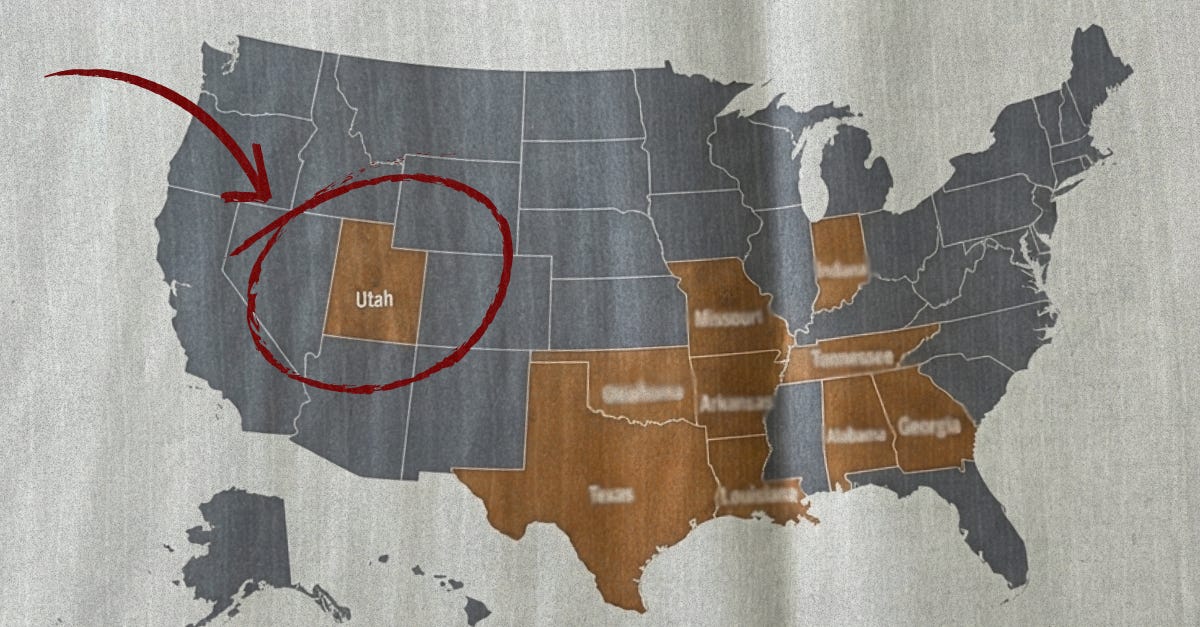
Those of us living in Utah - or even just consuming media related to our state - have consistently heard state leaders promulgate the idea that Utah is special. And US News & World Report provides some substantiation to the claim, ranking Utah the best state in the nation for three years running.
Meanwhile, CNBC recently named Utah as one of the ten worst states to live in for 2026. The report highlights some of Utah’s weak points, including healthcare, childcare, air quality, and worker protections. Though the methodology employed to determine this dubious distinction can be disputed, it’s clear that Utah’s ‘special’ status is not a foregone conclusion.
Regardless of how residents or onlookers view our state and its component parts, it’s common to acknowledge it reflects some degree of singularity. Some hold it up as a shining city on a hill, an aspirational model of what a state and community should be. Others see our state’s idiosyncrasies as problems, tainting a geographically beautiful state
So, which is it? Is there a secret sauce that makes Utah special? Or is it truly one of the worst places to live in the nation?
What Makes a Place Special Anyway?
If you’re like me, you likely assume a place is special because it has exceptional features: the most notable architecture, the most exciting events, memorable geographic features, famous landmarks, or the best dining. In other words, a special place is one you’d take a vacation to because it’s a must-see value proposition.
However, at the end of the day, no one finds meaning in their lives just because they live somewhere deemed cool by culture.
Instead, studies indicate a place becomes special through repeated positive experiences within a place, driving attachment to it. Interestingly, people are attached less to a physical landscape and more to the experiences and relationships that occur there. Place attachment significantly improves well being. And social capital, the intangible value derived from interpersonal connection, is a primary driver of both place attachment and well-being. There is even tangible wealth to be found in and generated through social capital. Places tend to feel like home - to feel special - when they have high rates of volunteerism, trustworthy neighborhoods, stable populations, active civic participation, and frequent informal connection (via parks, churches, shops, and events).
Additionally, nature is a critical part of what makes a place special as it contributes to well-being by enhancing place attachment and social relationships. A 2019 study found that the longer hikers spend somewhere, the stronger their place identity and social bonding becomes. Notably, surveys show that Utahns avail themselves of the outdoors at exceptionally high rates, with almost all walking or biking around their neighborhood, 82% visiting city parks, 78% walking local trails, and 67% recreating on public lands.
The “Utah is Awesome” Arguments
Utahns are consistently among the happiest in the nation, indicating some formula for success is at play here
Utah’s demographics and social structures drive social connectedness
Utah’s scenic geography lends itself to greater time outdoors, increasing place attachment
Happiness
Happiness is a difficult phenomenon to measure and quantify, let alone define, but WalletHub’s “Happiest States in America” ranking has consistently placed Utah amongst the happiest states in the nation over the past 10 years. In fact, the average rank during that time is 3.2, second only to Hawaii. The methodology has changed over time but this ranking typically evaluates economic, health, and social metrics to derive a figure.
Of course, while happiness is generally a byproduct of several key elements - meaning, purpose, and others - it’s not so simple that it can be universally indexed across a large population given a few socio-economic inputs. Having said that, WalletHub’s top-ranked states are in-line with historical rankings related to happiness and well-being published elsewhere. For example, Gallup’s well-being rankings from 2009 positioned Utah first, followed closely by Hawaii. This data was derived from interviews with residents of the respective states.
While Utah’s current ranking has slid to its lowest level in a decade (6th), the relative consistency of our state in these rankings indicates there’s a formula at play that’s built into the state’s very fabric. To much of the Western world, happiness is a sisyphean pursuit, but for many Utahns it seems to be part of a steady state.
Youth and Family
In addition to happiness, Utah’s people exhibit a vitality that’s difficult to ignore nor dispute. Part of this is youth. Our state’s median age is the lowest in the nation and a full 7 years younger than the national median. Utah’s birth rate, while falling and certainly nowhere near the historic levels used to caricature Utah’s families, is still among the highest in the nation. That young population, combined with a relatively high fertility rate, makes Utah’s birth-to-death ratio the highest in the nation. And our average household size is largest, with a greater share of married couples than any other state.
Fertility can reflect, in part, a belief that the future is stable and worth investing in. And children build social capital by increasing connectivity points in a community. Children can be social bridges who connect adults through school, sports, playgrounds, and general play. And adults who grew up with one or more siblings have significantly higher social capital than those without, showing that Utah’s current fertility rate and household size can perpetuate benefits for years to come.
Economic Dynamism
Beyond vitality, Utah exhibits dynamism on par with states that generate far more attention. It led the nation in real GDP growth for the last full year measured (2024). This is certainly driven by a number of factors, but there are plenty of states with pro-growth policies and educated workforces that fall short of Utah’s numbers. Looking deeper at what stands out from an economic perspective, it becomes apparent that our state’s entrepreneurship scene punches well above its weight.
Utah ranks 4th among states in VC dollars per resident at about $323 per person, behind California, Massachusetts, and New York and slightly ahead of Washington. Given the unique and historical advantages of these other states, it’s no small feat to be in such company. Most Utah entrepreneurs begin building their business by choice, not out of necessity, according to Kauffman data. And the average Utah startup creates just over 6 jobs within the first year, a rate higher than all but 3 other states.
Job creation matters because it increases opportunity while reducing stress. Social capital decreases when members of the community feel they’re participating in a zero sum game. And many of us know just how difficult it is to focus on higher-order social connection when you’re not sure if you can pay your bills or provide for your family.
Religiosity
While Utah’s relative entrepreneurial success may surprise some, its religiosity does not. If there’s anything that Utah is known for, it’s an association with Mormon Christianity. 76% of Utahns identify with a religious affiliation, the highest of any state. Percentages vary by study and methodology, but a large percentage of the state’s residents are members of the Church of Jesus Christ of Latter-day Saints. And while the state has become more secular in recent years, religiosity is still the norm.
It’s certainly in vogue to criticize organized religion and its adherents, but active participation in religious communities is associated with higher levels of social capital. Those who regularly attend religious services are more likely to volunteer in the community - and much of that volunteering occurs outside of a religious organization. Religious participation increases friendship, civic engagement, and trust.
Natural Resources
Finally, no examination of Utah’s notable characteristics is complete without highlighting its natural beauty. Utah has 5 national parks, tied for third most among US states. Collectively, these attract 11-12 million visitors per year, only exceeded by California. Zion National Park alone attracts more visitors than most US states. But it’s not just Utah’s national parks down south attracting visitors, it’s also world-class snow up north. Utah consistently ranks second among US states, behind only Colorado, and has arguably the best resorts in the country. No wonder our state is poised to host a second Winter Olympics in just the first half of this century.
Beyond beauty, our state is a rich source of the natural resources that facilitate modern life. As the nation’s number 2 producer of copper and only producer of beryllium and magnesium metal, it holds a crucial place in mineral supply chains. Throughout US history, Utah is the 3rd-largest metal-producing state by cumulative production value.
The “Utah Stinks” Arguments
The prevalence of mental health issues undermines the narrative that Utahns are happy, or at least indicates that some are left feeling isolated
Not everyone is equally valued here, with gender equality among the worst in the nation and many groups feeling unheard and powerless
Persistent air-quality issues literally overshadow an otherwise beautiful state
Mental Health
Although Utah consistently ranks among the happiest states in the country, it’s also one of the states with the highest prevalence of mental health problems. In fact, Utah has the second highest rate of adult mental health illnesses in the country - behind only Oregon. Yet, access to mental health care in our state is among the worst in the country.
It should be noted that individuals can report strong life satisfaction, community support, and optimism while still experiencing depression, anxiety, or other mental health conditions. Additionally, the drivers of this are myriad and difficult to attribute to any one cause. But, clearly, this is a widespread issue to be cognizant of. And a lack of resources could leave some individuals feeling isolated.
Social Spending and Resources
Utah consistently ranks among the healthiest states, but this is because of active lifestyles, low obesity, and low smoking rates. However, care remains a problem as primary care and mental health provider shortages persist, leading to long wait times.
Additionally, limited childcare availability, rising costs, and shortage of workers makes childcare difficult, particularly for dual income or single-parent families. Utah also has no paid family leave requirement and no paid sick leave requirement, potentially exacerbating childcare problems for working parents.
These may impact social capital indirectly as they reduce opportunities for connection and increase feelings of isolation. Additionally, a lack of resources can foster distrust and resentment, neither of which are desirable ingredients when building community.
Gender Equality
One of the most discussed issues among others in the state is gender equality. Utah’s women are among the healthiest in the nation, with excellent maternal and physical health outcomes, low smoking rates, relatively low obesity, and favorable health metrics. Additionally, women in Utah have relatively strong educational and employment outcomes. However, Utah has ranked last in gender equality for nearly a decade due to large gender gaps in earnings, executive leadership, and political representation. Some women feel these rankings are downstream from broader cultural norms.
It should come as no surprise that gender inequality - or even perceived inequality - can harm the trust and cohesion that are necessary to build social capital. Simply put, none of us enjoy being devalued. And individuals and groups who feel they have been are less likely to participate in the communities and organizations that foster that feeling.
Air Quality
Those of us who live along the Wasatch Front are all too familiar with regional haze and low visibility due to pollution. Utah’s unique geography, combined with western fires, extreme summer heat, ozone, and particulate matter make our state’s average air quality one of the worst in the nation. As alluded to, the drivers of this are myriad, and only certain portions of the state are subjected to poor air quality, but it’s a serious and unsightly issue nonetheless that threatens to undermine the benefits of healthy living and overshadow the state’s natural beauty.
In-groups and Out-groups
It’s genuinely difficult to quantify this, but anecdotal evidence and persistent talking points indicate many groups feel ostracized, unwelcome, or powerless. This phenomenon is certainly not unique to Utah, but decades of dominant religious and political groups have surely had an impact on minority groups. And feelings of alienation are likely to carry over into civic life. This may explain trends in political partisanship within the state. More specifically, Utah Democrats and unaffiliated voters tend to be more consistently liberal than their national counterparts, whereas Republicans appear to have a similar ideology to their national counterparts.
In 2016, Democratic gubernatorial candidate Mike Weinholtz held a fundraiser at a performance many members of the Church of Jesus Christ of Latter-day Saints found offensive. The play, titled “Saturday’s Voyeur”, parodied Church beliefs, policies, and its founder Joseph Smith. When confronted, Weinholtz dismissed criticisms, saying those offended “aren’t going to vote for me anyway[.]” More recently, Democratic congressional candidate Nate Blouin called members of the same faith “a bunch of bigoted assholes”.
Presumably, these candidates are outliers. But their mentality reflects a desperation that no longer seeks to build bridges, but rather “stick it” to those in power whom they feel have ignored or actively thwarted them. Resentment breeds an unstable and destructive brand of political engagement. Our leaders would do well to ensure all Utahns feel heard.
My take
Utah undoubtedly has its shortcomings, but they are largely superficial
Overall, Utah is special because of its tight-knit communities and kind people
So, is Utah special? Yes.
I’m a 7th generation Californian and have lived in 9 different states. I don’t have any childhood memories or visceral ties to Utah. But I remain here of my own volition.
There are plenty of things I’d like to change or improve in this state. For one, housing prices are now patently absurd. I’m entirely unmotivated to pay $800,000 for a fixer upper in Sandy (no offense to Sandy). That, to me, is not the American dream. Any American having that dream on a recurring basis should seek professional help.
I’ve also seen a lot of gatekeeping in professional circles. Larger cities have a wealth of top-tier, high-paying jobs. But they are still relatively hard to come by here, and those who occupy them are frequently threatened by any competition. I don’t have any data to back this up, and I’m not sure such data exists, but I’ve observed the goodwill normally extended to strangers suddenly ends when it comes to giving a hand up in certain industries.
Having lived much of my adult life in DC and New York, I’d love more sit down restaurant experiences and fewer fast casual chains. I also wish there were more walkable shopping districts, more distinctive communities, and less crowded canyons. Although, having said that last part, I’d also love to see nimbyism banished to the depths of hell. Wise stewardship of public lands is one thing; prohibiting newcomers from enjoying the same access you do is entirely another.
But these are all relatively benign. And none are universal. Furthermore, many of them are improving daily. New shops, restaurants, and communities continue to be built, enhancing the diversity and quality of experiences available to us. Better jobs and wages are coming. And Utah is building more homes than any other state in the nation, with a goal to build 35,000 new homes by 2028.
Social capital has recently fallen in absolute terms, as measured by Utah Foundation’s Social Capital Index. This is driven by a lower religious participation, less time with friends and neighbors, and more time alone. While this is a worrying trend, it can be reversed. And Utah still ranked #1 overall in relative terms last year - particularly with regards to community life.
Utah’s outdoor opportunities are unparalleled. States like California may have more diverse terrain and national parks, but it’s exceptionally rare to find those offerings right in your backyard. And how fortunate are we to be surrounded by incredible mountains as we’re cut off by a lifted truck with a Monster sticker on I-15? Here, there’s always a silver lining.
Ingroups and outgroups are undesirable and we should all work to cultivate and exhibit greater empathy and love. But conflict between such groups is primarily at the macro level, not at the micro. It’s easy to “otherize” an impersonal group or a label, but most Utahns are quite amiable and giving in their personal interactions.
At our best, Utahns celebrate success and the successes of others. This state is filled with people who are ambitious and hungry. And Utahns have a reputation for being hard-working and industrious. Perhaps these are reasons economic and social mobility in Utah are among the highest in the nation.
What makes our state special is not just one thing, but a collection of strengths born of Utahn’s fundamental desire to be and do good. I have personally been welcomed into hundreds of Utah homes and treated with kindness and generosity. Utahns are quick to give. They get involved. Many communities are filled with families who know and care for their neighbors. They are safe havens where households trust each other. Ultimately, people and connections have always been what makes Utah special.
Think we got this one wrong? We want to hear about it.
The sharpest reader responses may end up in a future article.
 | A guest post by
|